
ArcheoAmiata
Public Archaeology for Mount Amiata and Its Valleys
ArcheoAmiata is a public archaeology project created to bring together scientific research, local knowledge, and the communities of Mount Amiata and its surrounding valleys.
The project is based on a simple idea: Amiata’s archaeological heritage cannot be fully understood by studying the mountain, its slopes, and the surrounding valleys separately. Mount Amiata is part of a single, complex historic landscape shaped over thousands of years by the interaction of settlements, routes of communication, productive activities, the use of natural resources, and environmental change.
For this reason, ArcheoAmiata approaches the area from a diachronic, multidisciplinary, and integrated perspective, looking beyond modern administrative boundaries and including both the Grosseto and Siena sides of the mountain.
A Project Born from Encounter and Exchange
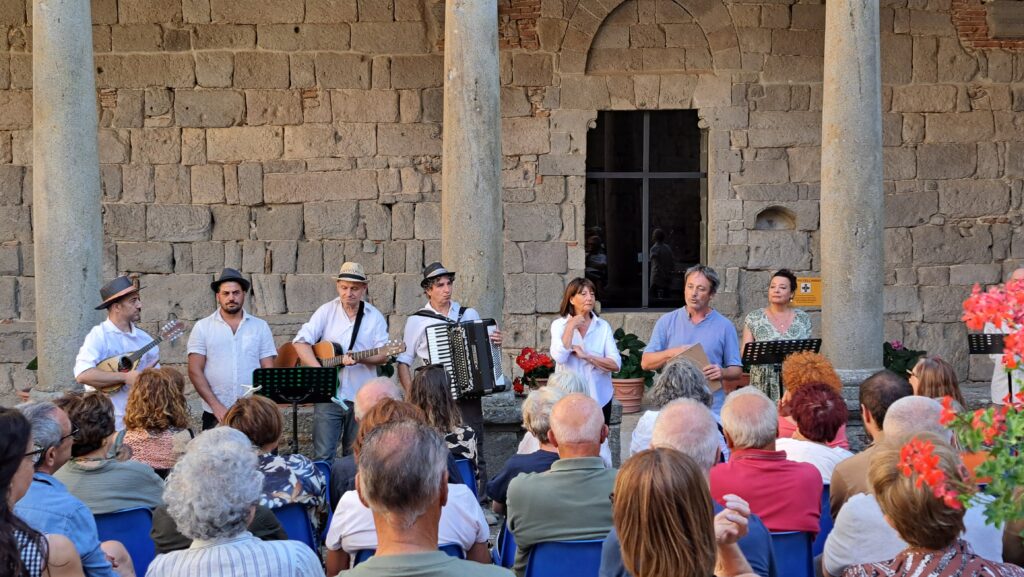
In 2024, ArcheoAmiata took shape through a series of public events in Abbadia San Salvatore and Castel del Piano, bringing together researchers, archaeologists, and university faculty who have studied Mount Amiata and its valleys from different perspectives.
But our goal was never simply to organize a series of lectures.
We wanted to create a meeting place between those who study the region professionally and those who know it because they live there, work there, and preserve its memory.
Researchers therefore presented the results of their work to the public while also listening to observations, questions, memories, and reports from local communities.
Public outreach thus became a two-way process: from research to the community, and from the community back to research.
This approach owes much to the contribution of Professor Franco Cambi, a leading scholar of the archaeology and historic landscapes of Mount Amiata, who helped shape the project and took part in several of its events.
From Local Stories to Shared Knowledge
But ArcheoAmiata’s success has depended above all on the participation of local communities, which gradually transformed the project from a simple series of public meetings into an informal network for sharing and expanding knowledge of the region.
Throughout 2025, the project continued through outreach, public engagement, and ongoing dialogue with local communities.
At the same time, we began collecting and organizing the many reports and observations coming from across the region: locally known sites, structures, chance finds, traces preserved in the landscape, place-names, documents, photographs, and memories that may contribute to reconstructing the history of Mount Amiata.
These reports now cover an increasingly broad area, from the Grosseto side of the mountain to the Siena side, and from the upper slopes to the surrounding valleys.
Not every report, of course, corresponds to an archaeological site. That is precisely why research is essential: each report must be assessed, compared with available documentation, and, whenever possible, placed within a broader historical and territorial context.
This is one of the fundamental principles of public archaeology: bringing scientific knowledge and local knowledge into dialogue without confusing their respective roles, while allowing both to contribute to a deeper understanding of the landscape.

Toward a New Archaeological Guide to Mount Amiata
ArcheoAmiata will continue in the coming years through research, documentation, public outreach, and continued engagement with local communities.
One of its main goals will be the creation of a new Archaeological Guide to Mount Amiata and Its Valleys.
We do not want it to be merely a catalogue of monuments or a collection of already known archaeological sites. Our aim is to create a resource capable of presenting the region as a whole: from prehistory to the modern era, from major archaeological monuments to the less visible traces preserved within the landscape.
The new Guide will therefore be based on bibliographic and archival research, fieldwork, and archaeological verification, but also on the body of information that local communities are helping to gather.
A Project Rooted in the Region
ArcheoAmiata is based on the belief that understanding cultural heritage is the first step toward protecting it.
For this reason, we continue to collect reports, information, historic photographs, documents, memories, and other evidence relating to archaeological sites and traces throughout Mount Amiata and its valleys.
All information is assessed with full consideration for heritage protection and for the confidentiality of sensitive archaeological locations.
Above all, ArcheoAmiata is a project built together with the region’s local communities: an ongoing dialogue between research and locals aimed at understanding, interpreting, and protecting the historic landscape of Mount Amiata and its valleys.
ArcheoAmiata Needs Your Knowledge
ArcheoAmiata is a project created for and with local communities.
If you have suggestions, reports of archaeological sites or traces, local information, memories, historic photographs, documents, or simply a comment to share, please get in touch with us through our contact form.
Your knowledge of the territory can help us better understand and protect the history of Mount Amiata and its valleys.